1. What happened
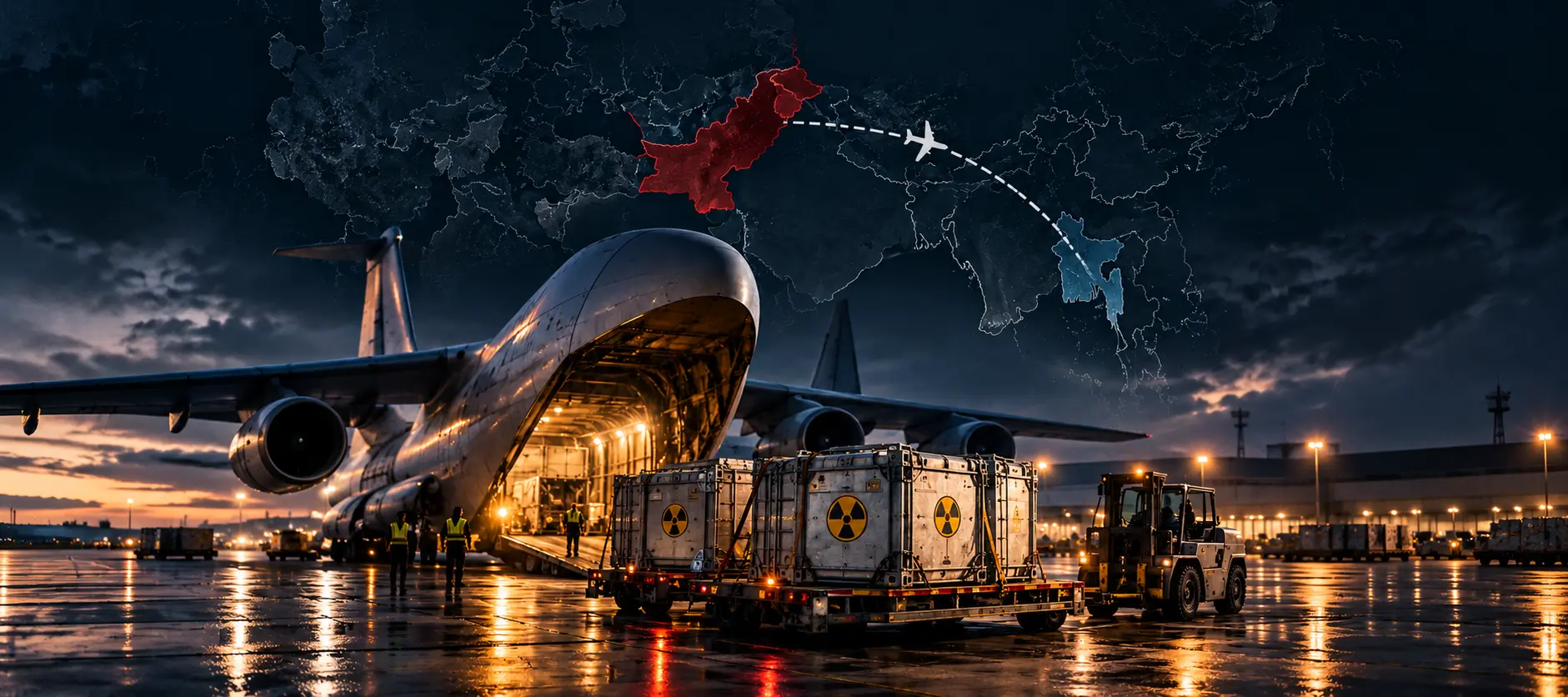
A Russian flight carrying nuclear fuel for Unit-2 of Bangladesh’s Rooppur Nuclear Power Plant, due in Dhaka on 24 Sep, was not given Pakistani airspace clearance at the last minute. Rosatom has rerouted the delivery and says fuel shipments resume in October with no schedule impact.
| Item | Detail |
| Cargo | First fuel batch for Rooppur Unit-2 (Rosatom supplies the uranium fuel) |
| Planned route | Russia, then Azerbaijan, Kazakhstan, Pakistan, India, Dhaka |
| Planned arrival | 24 Sep 2026; airport preparations complete when Rosatom reported no clearance |
| Bangladesh position | Science & Technology Minister Faqir Mahbub Anam confirmed the denial; no reason received. BAEC silent on which country refused |
| Pakistan position | High Commission in Dhaka cites “technical” and “procedural issues”; asks that the matter not be over-read |
| Diplomacy | Pakistan High Commissioner Imran Haider met Junior Foreign Minister Humaiun Kobir on Mon 28 Sep; the airspace issue was “not discussed” |
| Rosatom plan | Alternative route; remaining fuel to arrive by December on 7 separate cargo flights; “schedule won’t be impacted” |
| Plant status | Unit-1 fuel loaded Apr 2026; final tests from Aug; about 300 MW trial power to the grid in October; commercial operation targeted for December; 2 units total 2,400 MW |
| Context | Bangladesh’s worst power crisis in decades for 2+ months: 10 to 16 hours of rural load-shedding; garment, food, ceramics and pharma factories cutting output; first major test for the Tarique Rahman government |
2. Why it matters
A new irritant inside a worsening trend. The airspace refusal itself is a one-off logistics setback. It matters because it hits the one project Bangladesh is counting on to ease a gas-driven power crisis. It also exposes how fragile its new tilt toward Pakistan is.
- Rooppur is Bangladesh’s main structural fix. Gas demand for power is about 3,800 million cubic feet a day (MMcfd), but July to August supply was about half that. Load-shedding peaked above 3,500 MW, and contracted LNG imports largely stopped after the Iran war closed Hormuz. Rooppur’s 300 MW trial in October covers under 10% of that shortfall, and the full 2,400 MW covers most of it once both units run.
- The fuel route is a choke point. Russian nuclear fuel is flown to Dhaka over third countries. Radioactive (Class 7) air cargo needs specific overflight approval from each state crossed. One refusal reroutes the whole chain, and Rosatom now needs 7 more flights by December.
- The Dhaka–Islamabad thaw is tested. Since 2024, Dhaka has courted Islamabad. Pakistan’s “technical” explanation and a High Commission meeting that skipped the topic suggest both sides want to contain it. The episode still hands critics a ready example. Pakistan–India airspace restrictions in place since 2025 may also have complicated a route that crossed both countries; that link is our inference, not confirmed.
- The political clock is short. The crisis is the Tarique Rahman government’s first major test. Any slip in Rooppur’s October trial or December commercial date would deepen public anger.
3. Market impact
The fuel delay itself has no direct market price. What it threatens is the timing of relief for a power grid short by up to 3,500 MW while spot LNG costs about 2.3 times last year’s level.
| Market | Level | Move | Read-through |
| Asian spot LNG (JKM) | US$25.74/MMBtu (30 Sep) | +13% m/m; +133% y/y | Bangladesh buys spot cargoes at these prices because contracted Qatari supply is disrupted; every MW Rooppur adds cuts LNG demand |
| Bangladesh gas supply | About 2,650 MMcfd total (1,698 domestic, 952 LNG), against about 3,800 demand | Domestic output falling for 9 years (2,700 in 2018 to under 1,700 now) | Structural deficit; 2 floating LNG terminals, each a single point of failure |
| Power shortfall | Load-shedding up to 3,500 MW; peak 3,000 MW+ in Aug | Gas supply at a 16-year low in Jul to Aug | Rooppur trial of 300 MW in Oct covers under 10%; full 2,400 MW covers most of the gap |
| Garment output | About 40% of normal capacity at the August low (BGMEA); estimates of 30% to 40% cuts | BGMEA sought 1 to 2 week shipment extensions | Delivery risk for Q4 holiday orders |
| Export earnings (EPB) | Aug 2026: US$4.42bn total, RMG US$3.60bn | +13.1% y/y (RMG +13.9%) after -0.9% in July | Shipments are holding so far on buffer stock and generators; September data (due early Oct) is the test |
| RMG exports to US | US$1.61bn Jul to Aug | +11.4% y/y | US buyers (Walmart, Gap, H&M, Zara) still placing orders despite the crisis |
| Freight and war-risk insurance | Not directly affected | n/a | Rosatom air cargo is rerouted; no sea-lane effect |
4. Who is affected
Bangladesh’s garment exporters and their global buyers carry the cost of any Rooppur slip; Indian power exporters and LNG sellers gain from a longer crisis.
| Group | Named players | Effect | Direction |
| Nuclear project | Rosatom (contractor and fuel supplier), Bangladesh Atomic Energy Commission (BAEC), Nuclear Power Plant Company Bangladesh | Rerouting cost; 7 more fuel flights needed by December; reputational test | Mild negative |
| Garment and textile exporters | BGMEA and BKMEA members; dyeing and knitting hubs in Narayanganj, Gazipur, Savar, Chattogram | Output cut by up to 60% at the low; generator diesel costs; late shipments | Hit |
| Global apparel buyers | Walmart, H&M, Inditex (Zara), Gap, Primark, VF Corp, American Eagle | Q4 holiday delivery risk; extra air freight | Hit |
| Other gas-dependent industry | Ceramics (RAK Ceramics BD), pharma (Square, Beximco), food processing, shrimp (Khulna) | Production cuts reported | Hit |
| Power utilities | Bangladesh Power Development Board, PGCB, Petrobangla, RPGCL | Higher spot LNG bills, subsidy burden | Hit |
| Electricity exporters | Adani Power (Godda plant, Jharkhand), Indian grid exports via NVVN and PTC | Bangladesh leans more on Indian power while Rooppur is delayed | Benefit |
| LNG suppliers | Spot sellers and traders; floating terminal operators Excelerate Energy and Summit LNG | More spot demand, at high prices | Benefit |
| Pakistan–Bangladesh ties | Islamabad; Dhaka’s Foreign Ministry | Rapprochement since 2024 dented; Pakistan stresses “technical” cause | Strained |
Geographies and routes: fuel airlift from Russia via Azerbaijan and Kazakhstan; Pakistani and Indian airspace on the original plan; Rooppur, Pabna district, on the Padma River.
Supply chains at risk: apparel from Bangladesh (about 84% of exports) to the US, EU and UK; garment inputs (dyed fabric) that need gas; rural agriculture (irrigation pumps) during load-shedding.
5. Scenarios (next 2 to 8 weeks, to late Nov 2026)
Unit-1 already has fuel loaded, so the October trial does not depend on this shipment; the Unit-2 timeline and political trust do. Probabilities are our estimates.
| Scenario | Trigger | Probability | Rooppur outcome | Impact |
| De-escalation | Rosatom flies Unit-2 fuel via an alternative route in October; Pakistan grants clearance for later flights or the issue fades; Hormuz LNG flows keep recovering | 45% | Unit-1 300 MW trial in Oct; commercial operation in Dec on schedule | Load-shedding eases toward 1,000 to 2,000 MW as winter cuts demand; garment output recovers |
| Base case | Fuel flights proceed via a longer route; minor slippage; Unit-1 trial slips 2 to 4 weeks for technical reasons unrelated to fuel | 40% | Trial in Nov; commercial operation in Jan 2027 | Crisis lingers through November; export shipments slip 1 to 2 weeks; political pressure on Dhaka builds |
| Escalation | Further overflight denials (another state joins); sanctions or payment problems on Russian deliveries; an LNG terminal outage | 15% | Unit-2 fuel delayed into 2027; Unit-1 commercial date at risk | Load-shedding back above 3,000 MW; buyer order shifts to Vietnam, India and Cambodia; strain in Pakistan–Bangladesh ties |
6. Actions to consider
Assume Bangladesh power relief arrives no earlier than December. Plan Q4 apparel sourcing with 1 to 2 weeks of slack and a second source for priority lines.
Procurement (apparel and textile buyers)
- Ask Bangladeshi suppliers for factory-level energy status (grid hours, captive gas, generator coverage) and weekly output against plan through December.
- Pull Q4 holiday orders forward 1 to 2 weeks or split 15% to 25% of volume to Vietnam, India or Cambodia for critical styles.
- Accept partial air freight for late lines where margins allow; pre-book Dhaka air capacity, which tightens when sea shipments slip.
Logistics
- Add 7 to 14 days of buffer to Chattogram departures for November and December deliveries.
- Track the BGMEA requests for shipment extensions; agree revised dates in writing.
Legal
- Check whether power outages caused by fuel shortages count as force majeure in your supplier contracts; document notices from suppliers now.
Finance and energy
- For businesses in Bangladesh, budget for generator diesel and higher grid tariffs (LNG bought at about US$26/MMBtu) through Q1 2027.
- For investors in Indian power exporters (Adani Power) and LNG shippers, treat any Rooppur slippage as a short-term demand upside.
7. What to watch next
The decisive signal is the Rooppur Unit-1 grid synchronisation in October: 300 MW reaching the grid on time means the airspace issue was a sideshow; a slip shifts relief into 2027.
| Indicator | Who / when | Current reading | Trigger and inference |
| Rooppur Unit-1 trial power | BAEC, Rosatom; October | About 300 MW trial planned | Grid sync by end-Oct = on track; slip past Nov = commercial date at risk |
| Unit-2 fuel flights | Rosatom; Oct to Dec | First batch rerouted; 7 flights to go | Each arrival confirmed = de-escalation; another denial = escalation |
| Pakistan stance | Pakistan High Commission, Foreign Office | “Technical, procedural” | Clearance granted for later flights = issue closed; silence or further denials = political signal |
| Dhaka response | Bangladesh Foreign and Science ministries | Not formally raised | A formal protest = rapprochement under strain |
| Load-shedding | PGCB daily data | Up to 3,500 MW at peak | Below 1,500 MW in Nov = crisis easing (winter demand) |
| LNG supply | Petrobangla, RPGCL tenders; QatarEnergy force majeure | Contract cargoes largely halted; spot JKM US$25.74 | Qatari cargo resumption = biggest relief; terminal outage = escalation |
| September exports | EPB; early October | Aug +13.1% y/y | A y/y fall = crisis now hitting shipments |
| Hormuz and Iran talks | US-Iran negotiations; Kpler flow data | Hormuz flows about 77% of pre-war | A deal reopening Hormuz cuts LNG prices and eases Bangladesh’s crisis faster than Rooppur |
8. Bottom line
Pakistan’s airspace refusal delays Rooppur Unit-2 fuel, but Rosatom says 7 rerouted flights by December keep the schedule. The real risk is Unit-1’s 300 MW October trial: Bangladesh is short up to 3,500 MW and garment output fell to about 40% of capacity.